The Li Research Group | City University of Hong Kong
Our research resides at the intersection of physics-informed machine learning, stochastic optimization, and real-world deployment. We develop the intelligence required to manage the world’s most complex and high-stakes operational systems.
I. Air Transportation Systems
Developing the “Proactive Intelligence” required for aviation safety and efficiency.
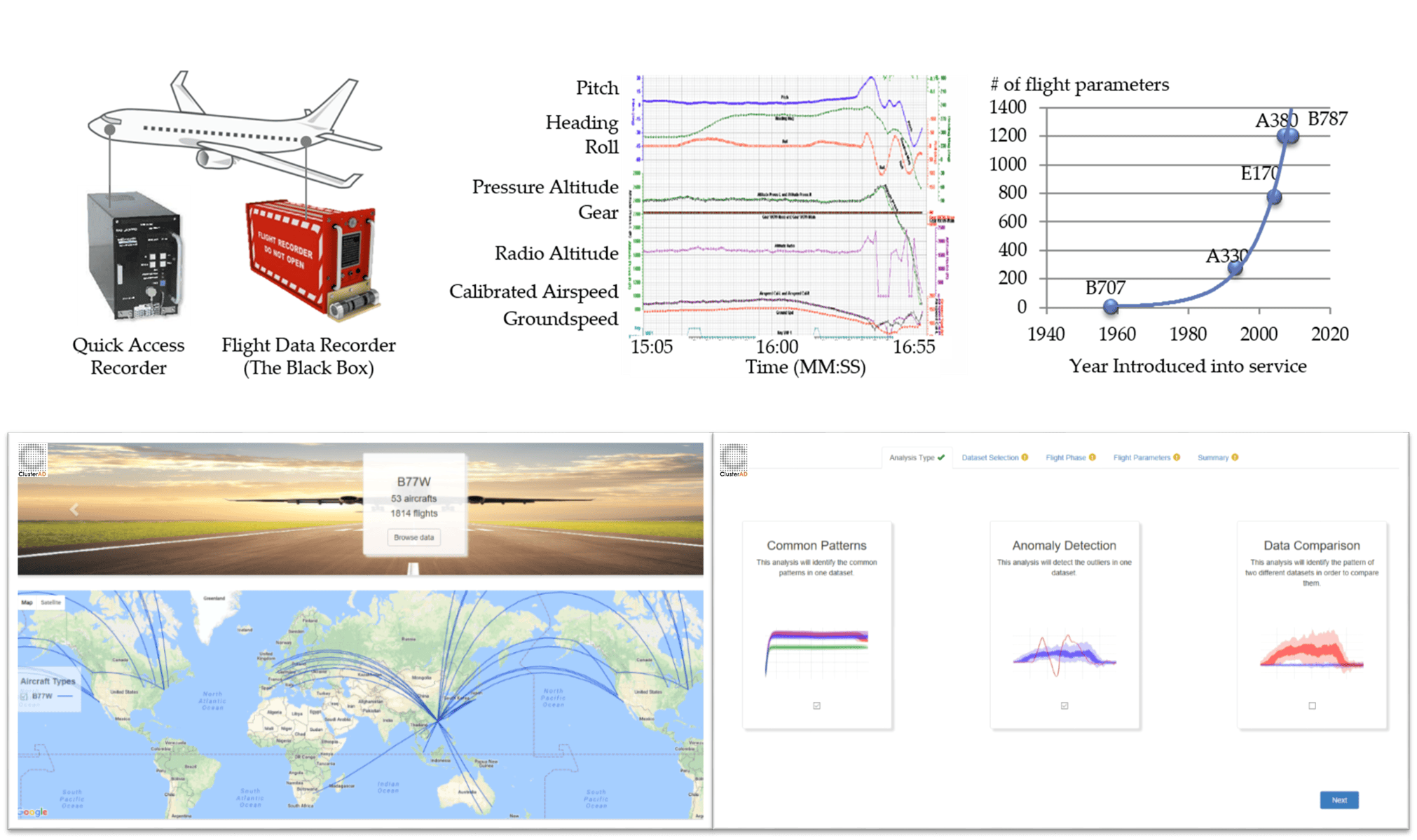


Our work in aviation safety moves beyond traditional exceedance detection toward proactive, data-driven monitoring. By leveraging large-scale Flight Data Recorder (FDR) and surveillance data, we help the industry anticipate risks and optimize resources.
Impact Highlight: Research cited and utilized by NASA, EASA, and CAAC; featured in MIT News and Flight International.
Proactive Safety Management (ClusterAD): We developed the ClusterAD framework to identify operational risks in flight data through incremental clustering and Gaussian Mixture Models.
- Selected Publications
- Analysis of flight data using clustering techniques for detecting abnormal operations. Li et al., Journal of Aerospace Information Systems (2015). [DOI] | [PDF]
- Anomaly detection via a Gaussian Mixture Model for flight operation and safety monitoring. Li et al., Transportation Research Part C (2016). [DOI] | [PDF]
- Invited Talks
- “Analysis of flight data using clustering techniques for detecting abnormal operations”, European Aviation Safety Agency (EASA) Flight Data Monitoring (FDM) Conference, Cologne, Germany, 2017.
- “Using big data in monitoring normal operations”, International Flight Crew Training Conference 2017, Royal Aeronautical Society, London UK, 2017.
- “AI for Flight Time Prediction and Fuel Management“, KLM Webinar series – AI for Sustainability, Amsterdam, Netherlands, 2022.
- “Anomaly Detection and Pattern Recognition in Flight Data for Airline Safety Management”, Applied Machine Learning Days (AMLD) at EPFL, Switzerland, 2020. [Watch Video]
- Patent
- US Patent No. 11,299,288: Method of Presenting Flight Data of An AircraftLi, L., Charruaud, F., Zhao W. (2022)
- Media
Operational Optimization & Fuel Intelligence: We utilize deep learning to provide high-accuracy flight time predictions, enabling airlines to make data-informed fuel loading decisions that balance safety with environmental sustainability.
- Selected Publication
- Flight time prediction for fuel loading decisions with a deep learning approach. Zhu & Li, Transportation Research Part C (2021). [DOI] | [Pre-print PDF]
- Multi-Graph Convolutional-Recurrent Neural Network (MGC-RNN) for Short-Term Forecasting of Transit Passenger Flow. He et al., IEEE Transactions on Intelligent Transportation Systems (2022) [DOI] [Citations: 100+]
- High-Speed Rail Suspension System Health Monitoring Using Multi-Location Vibration Data. Hong, et al. IEEE Transactions on Intelligent Transportation Systems (2020) [DOI]
Airspace and Traffic Analytics: We conduct comparative benchmarking of air traffic flows across major global hubs, utilizing ADS-B data to model network delays and identify en-route congestion bottlenecks.
- Selected Publications
- Flight trajectory data analytics for characterization of air traffic flows: A comparative analysis of terminal area operations between New York, Hong Kong and Sao Paulo. Murça et al., Transportation Research Part C (2021). [DOI]
- Characterizing air traffic networks via large-scale aircraft tracking data: A comparison between China and the US networks. Ren, P., & Li, L. Journal of Air Transport Management (2018). [DOI]
From Airspace to Outer Space: We introduced a diffusion-based framework for identifying satellite “Patterns-of-Life,” establishing a new standard for behavioral monitoring within Space Traffic Management to ensure long-term orbital safety and sustainability.
- Selected Publications
- Award
- MIT ARCLab Prize for AI Innovation in Space, 2024, 6th Place. [CityU News Link] [MIT News Link]
II. Low-Altitude Economy (LAE)
Scaling urban air mobility through intelligent traffic management.
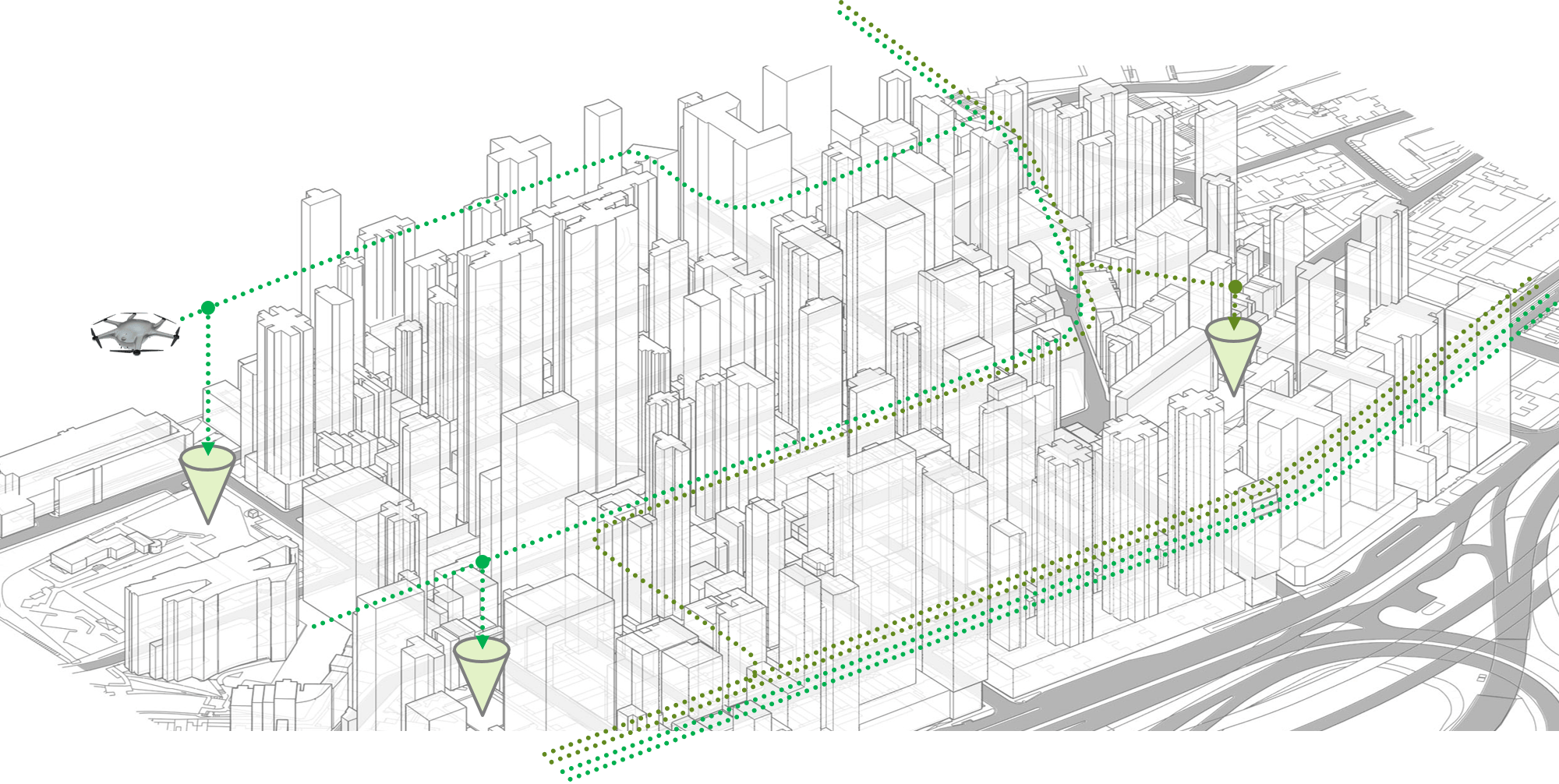
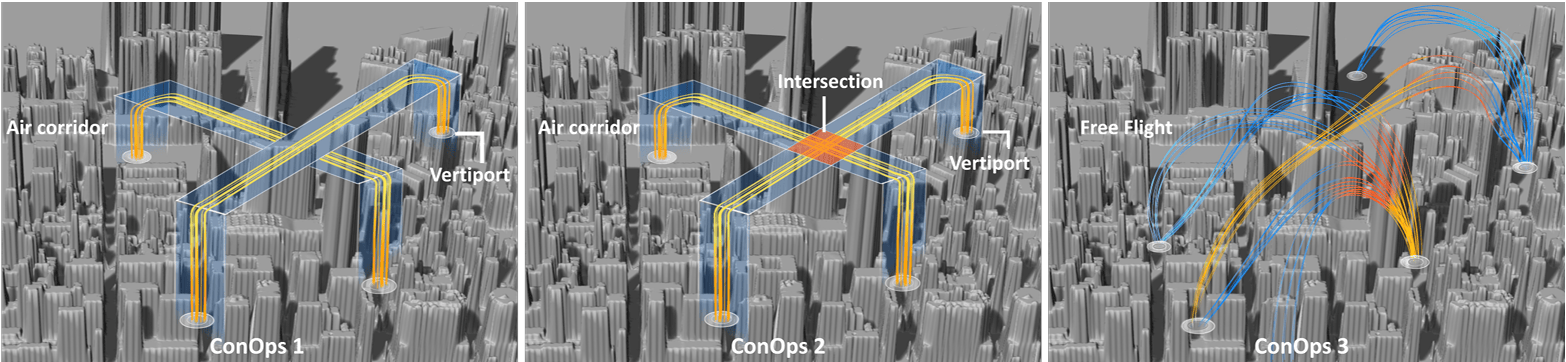
As urban skies become a new frontier for logistics, our team develops the “operating system” for drone delivery and tourism. We focus on the core challenges of scaling multi-operator flight operations in high-density urban environments.
- Path Planning (CitySkyPlan): We design grid-based path search and Transformer-based reinforcement learning frameworks for dynamic drone routing. This work is protected by US Patent No. 11,915,599, and No. 12,560,943
- Unmanned Traffic Management (UTM): Our research develops “Air Corridors” and 4D trajectory management systems that consider urban wind effects (CFD simulations), third-party risk, and congestion pricing.
Impact Highlight: collaborations with industry partners, Antwork Robotics and Meituan to deploy real-world drone delivery solutions.
- Patents
- US Patent No. 12,560,943: Route Network Planning for Drone Logistics in Urban Environment Li, L., He, F., Zhang, L., He, X. (2026)
- US Patent No. 11,915,599: Grid Based Path Search Method for UAV Delivery Operations in Urban Environment Li, L., He, F., Zhang, L.(2024)
- Selected Publications
- Air corridor planning for urban drone delivery: Complexity analysis and comparison via multi-commodity network flow and graph search. He et al., Transportation Research Part E (2025). [DOI]
- A distributed route network planning method with congestion pricing for drone delivery services in cities. He et al., Transportation Research Part C (2024). [DOI]
- A route network planning method for urban air delivery. He et al., Transportation Research Part E (2022). [DOI]
- Path pool based transformer model in reinforcement framework for dynamic urban drone delivery problem. Xiang et al., Transportation Research Part C (2025). [DOI]
- Talks & Press
- Invited Talk: AI Symposium @ A*STAR, Singapore, 2026. AAAI AI4AT Workshop, Singapore, 2026
- Media: “城大學者研無人機「城市智能空路」 日內瓦國際發明展奪銀獎” by Sing Tao Daily, May 2024.
III. Industrial Intelligence
Translating system monitoring into business and environmental excellence.
We apply Control Theory, Stochastic Optimization, and Large Language Models (LLMs) to critical infrastructure and manufacturing, ensuring that complex systems remain reliable and energy-efficient.


- Process Optimization: Our “Data-to-Deployment” framework integrates machine learning and expert experience to optimize industrial processes, reducing energy consumption while maintaining product and business performance.
- Infrastructure Health Monitoring: We develop data-driven, physics-interpretable models for Prognostics and Health Management (PHM) of high-speed rail suspension systems and satellite Solar Array Drive Assemblies (SADA).
- Selected Publications
- An industrial process optimization framework: from data to deployment with case studies in food production processes. Liu, et al., Journal of Intelligent Manufacturing (2025) [DOI]
- Pre-print
IV. Beyond the Hangar
Exploring the intersection of data, society, and human behavior.
While our core focus remains on industrial operations, we believe the tools of data science are universal. Driven by curiosity, we occasionally apply our analytical frameworks to understand the “pulse” of the cities we live in and the people who move through them.